The application: from hydraulic pilot control to CAN bus
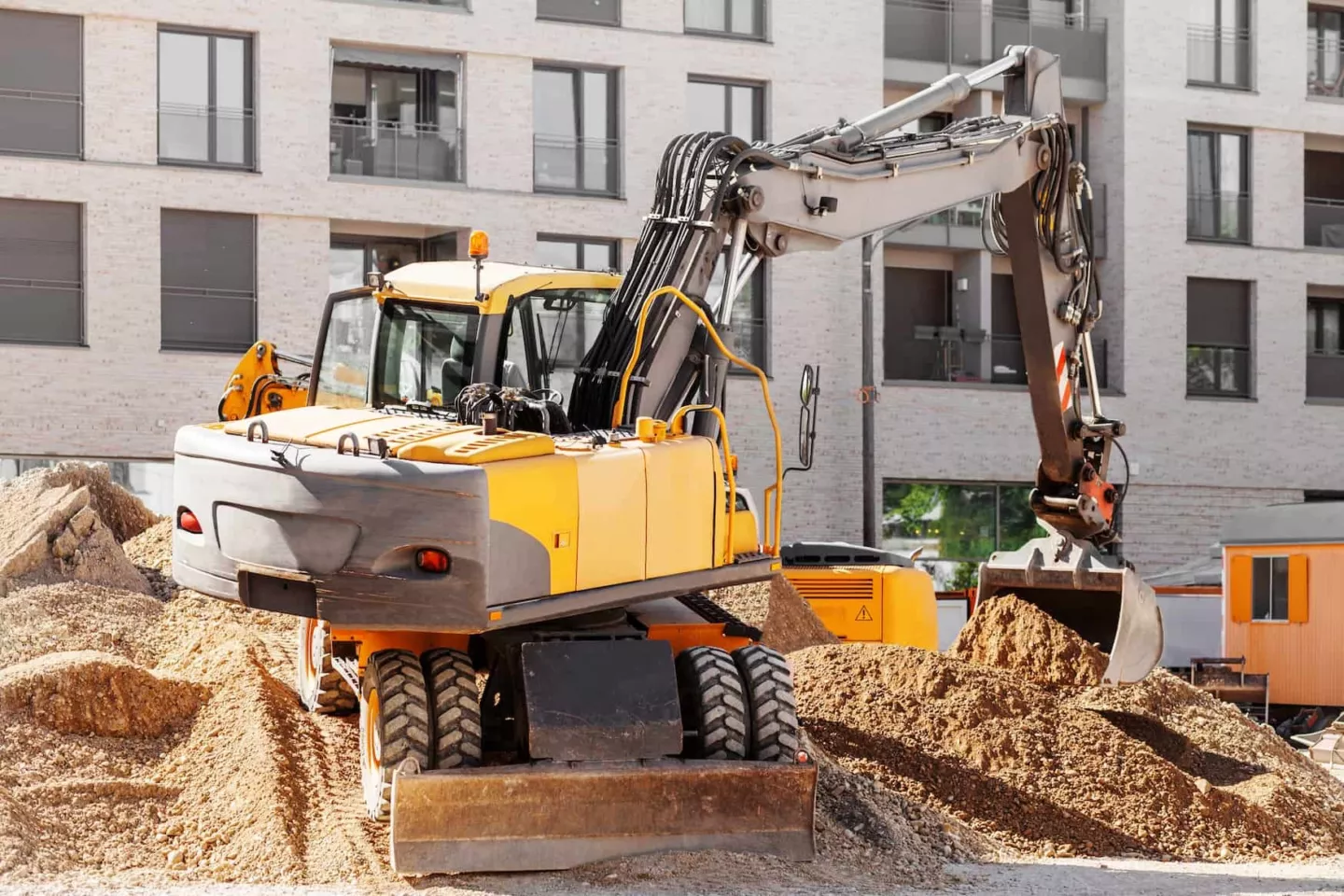
In a conventional hydraulic pilot-operated excavator, the joysticks send pilot pressure to the main control valve. In an electrohydraulic system, the joysticks transmit electronic position signals to the machine controller, which operates the proportional valves for boom, arm, bucket and swing.
This architecture enables features such as switchable ISO and SAE control patterns, adjustable response curves and integration with grade control and operator assistance systems, depending on the machine controller.
A wheeled excavator also requires travel direction control and auxiliary hydraulic functions for attachments such as tiltrotators. Multi-function joystick grips allow operators to access these functions without releasing the main controls.
The challenge
- Familiar control feel: A smooth transition from hydraulic pilot valves to electronic joystick control.
- Tactile feedback: A noticeable increase in operating force towards the end of the joystick travel.
- All functions at hand: Travel direction, proportional auxiliary control and additional grip buttons within easy reach.
- CAN bus integration: Two excavator joysticks sharing one CAN J1939 network, mounted in the left and right armrests.
The solution
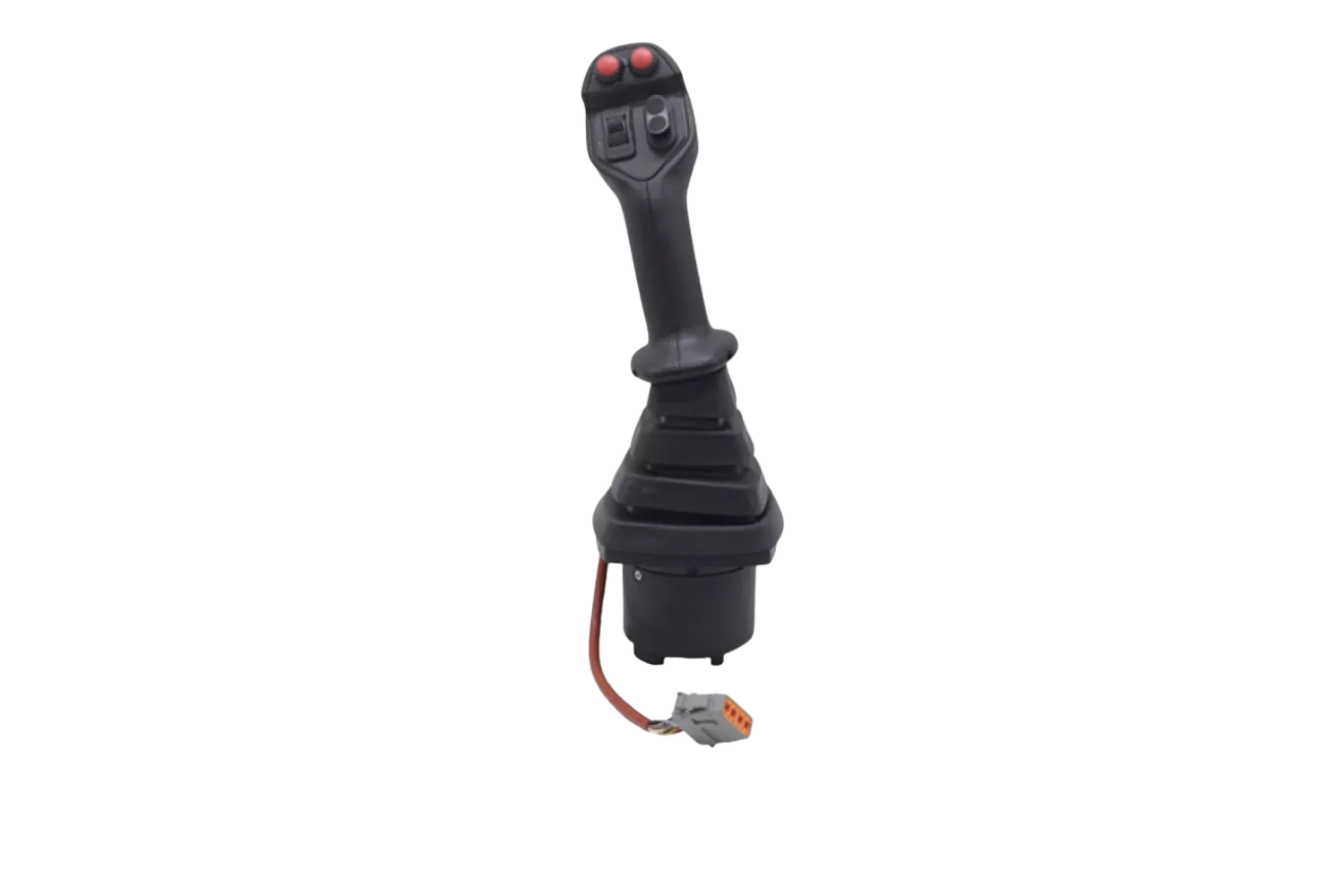
Two H4 Series excavator joysticks are configured for dual-axis operation with spring return. Designed to reproduce the familiar operating feel of hydraulic pilot valves, the H4 supports a smooth transition to electrohydraulic control. Its two-stage stroke provides tactile feedback in all four directions: operating force increases from 6 to 10 N to 18 to 20 N towards the end of travel.
The joysticks are available in left-hand and right-hand versions, with handles tilted 15° inwards for a natural wrist position. Both feature K12 multi-function grips. In this configuration, the left grip combines an FNR switch for travel direction, a thumbwheel for proportional auxiliary hydraulic control, two front buttons and an additional rear button.
Both Hall effect joysticks communicate with the machine controller via CAN J1939 at 250 kbps. Separate node addresses allow the left and right joysticks to share one CAN bus without address conflicts. For machines using CANopen, the H4 is also available with CANopen output. A 6-pin Deutsch DT04-6P connector provides a sealed, service-friendly connection.
Product used: 2 x H4 Series with K12 grip, CAN J1939
- Dual-axis operation in any direction, spring return
- Two-stage stroke in all four directions
- K12 grip on the left joystick: FNR switch, thumbwheel, 2 front buttons, 1 rear button
- Left-hand and right-hand versions, handle tilted 15 degrees inwards
- CAN J1939 output, separate node addresses for left and right joystick
- 6-pin Deutsch DT04-6P connector
Technical specifications
- Sensor technology: non-contacting Hall effect
- Travel angle: ±20° (other travel angles can be customized)
- Operating force: 6 to 10 N, 18 to 20 N in the end stroke (measured 195 mm from pivot)
- Mechanical life: 5 million cycles
- Supply voltage: 9 to 32 Vdc, current consumption below 55 mA
- Output: CAN2.0b, J1939 (250 kbps) or CANopen (10 kbps to 1 Mbps)
- Operating temperature: -25 °C to +85 °C
- Panel mounting: from the top, panel thickness 3 to 5 mm
Customized to the machine
The H4 is a configurable industrial joystick platform with 16 stroke configurations, allowing the operating characteristics to be adapted to each direction. K12 and K14 multi-function grips are available, with left-hand, right-hand or vertical mounting options.
Besides CAN J1939 and CANopen, the H4 supports ratiometric analog outputs, including redundant inverse signals for integration into safety-related control systems. Connection options include 4-pin and 6-pin Deutsch connectors or a cable connection. The travel angle can also be customized to suit the machine.
Operational benefits
- Familiar control feel: Operating characteristics similar to hydraulic pilot valves support the transition to electrohydraulic control.
- Precise metering: Two-stage stroke provides tactile feedback between fine control and the end of joystick travel.
- Functions within reach: Travel direction, proportional auxiliary hydraulics and additional controls integrated into the K12 grip.
- Simplified CAN integration: Two joysticks share one CAN J1939 network using separate node addresses.
- Easy installation: Sealed Deutsch connectors and top-down panel mounting simplify assembly and servicing.
Product used
Discover the joystick in this application
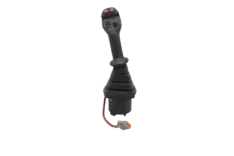
H4 serie meerassige Cobra joystick
- Hall-effect technologie
- CANbus-uitgang
- Configureerbare kracht

Developing an electrohydraulic excavator or converting an existing machine?
Our Controls specialists can help you select and configure the right joysticks for your application.